
Photo credit: Roy Lowe, USFWS.
The Marbled Murrelet
A sea bird that trades the ocean for old-growth forests.
By Chelsey Cook
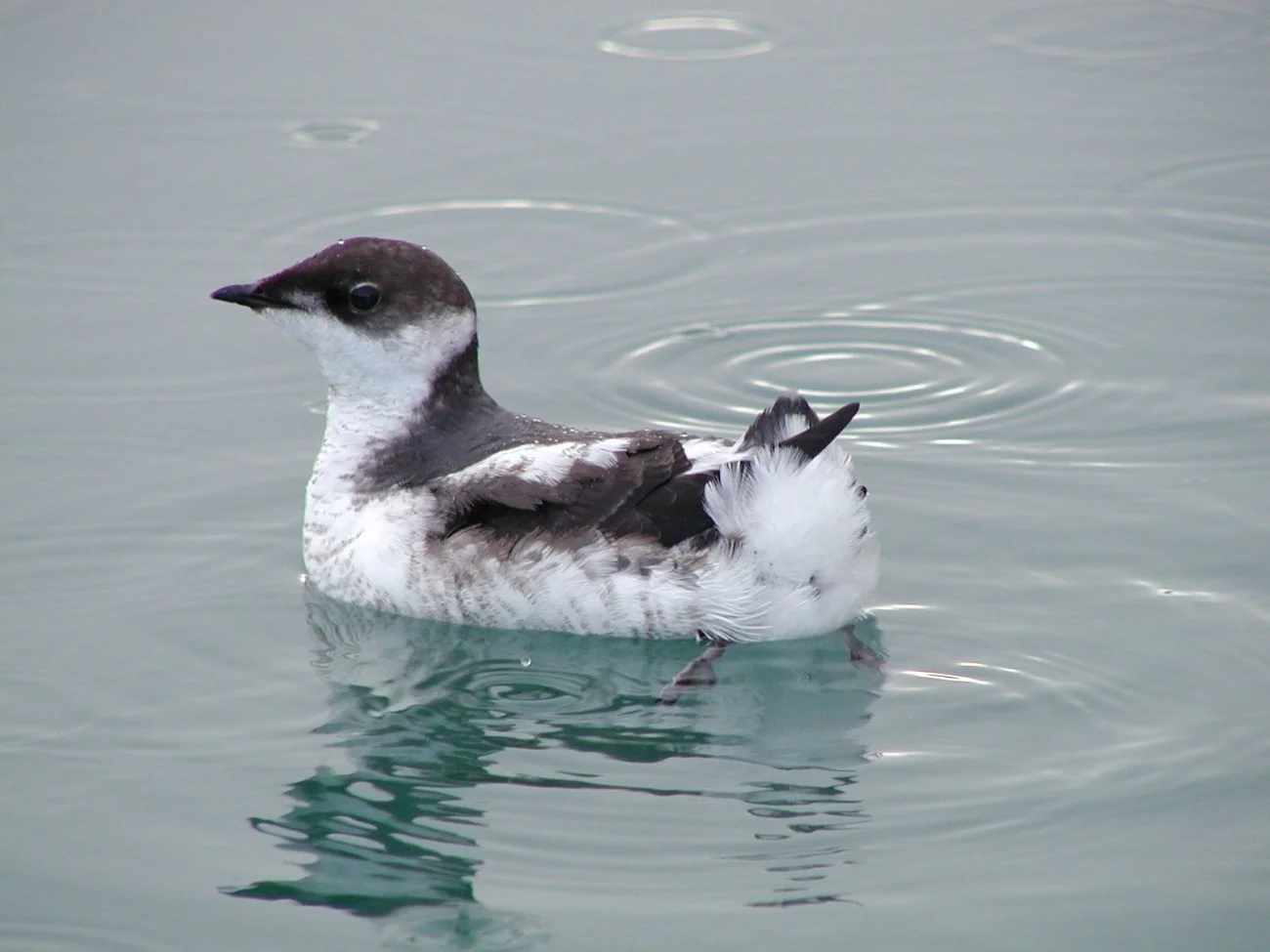
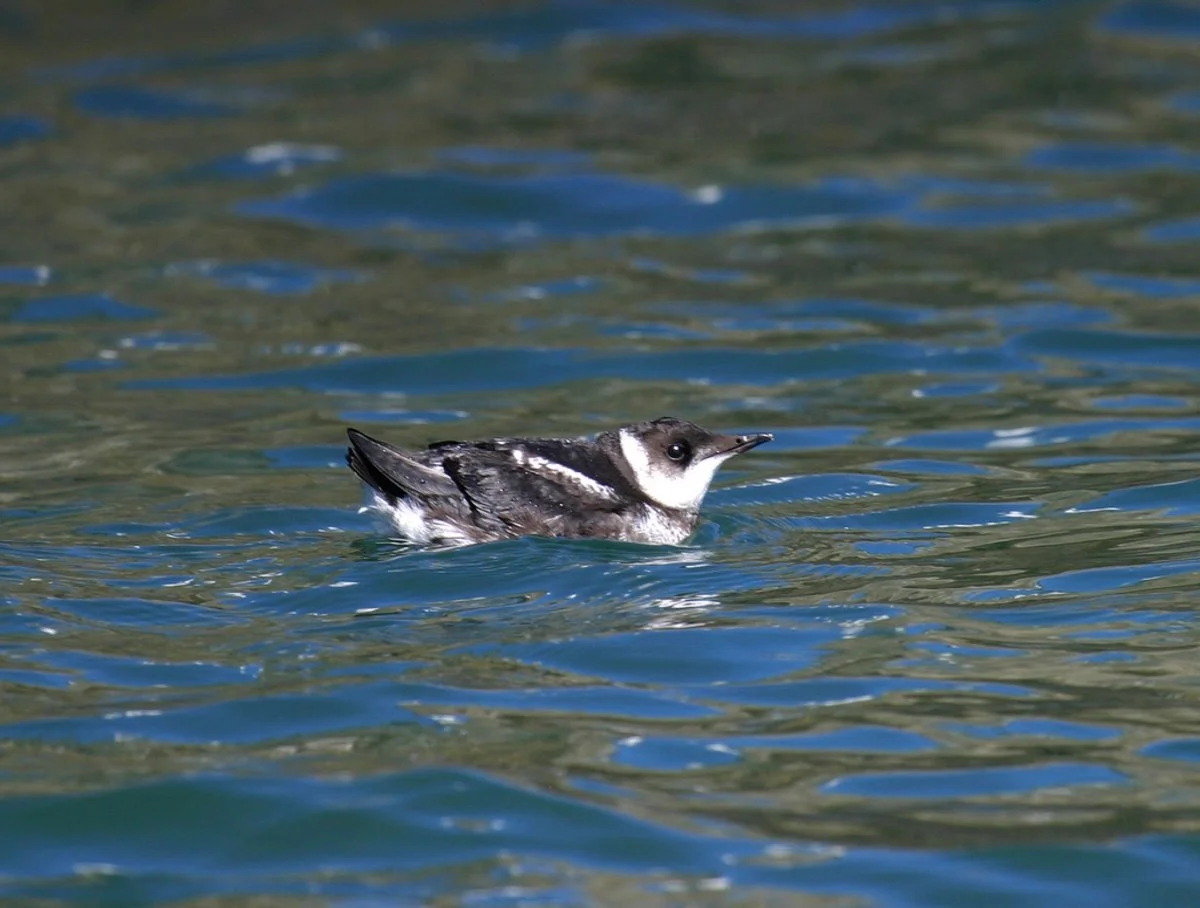
Marbled Murrelets (Ch’eet in Tlingit) have been my steady companions the last two summers in Prince William Sound. The seabird, referred to by nature writer Maria Mudd Ruth as “a chunky baked potato of a bird”, is a frequent sight near the rocky coastlines. Almost always in pairs, the robin-sized birds are often bobbing around in the swell, diving for forage fish with a quick flick of their wings or taking to the air to chase each other across the water.
While always entertaining to watch, there’s another reason to love these small birds: they managed to keep their nesting habitats hidden from the world until 1974! Tree surgeon Hoyt Foster was trimming Douglas fir trees in California's Big Basin Redwoods State Park when he discovered a fluffy marbled murrelet chick 148 feet up in the tree, the first officially documented nest. This secrecy earned Marbled Murrelets the nickname the “enigma of the Pacific”.
DID YOU KNOW…
Unlike most seabirds, Marbled Murrelets nest high on old-growth tree branches rather than on cliffs or the ground.
Murrelets will travel anywhere from a few miles up to 50 miles inland from the ocean to find suitable nesting habitat.
The oldest known Marbled Murrelet was at least 10 years old when it was recaptured during a long-term study of nesters in British Columbia in June 2006.
Marbled Murrelets dive for their food, opening their wings to “fly” underwater and steering with both wings and feet.
Photo credit: R. McIntosh, USGS.
SCIENTIFIC AND COMMON NAMES
Brachyramphus marmoratus. Ch’eet in Tlingit. Known to fishermen and loggers as “fog bird” and fog lark”.
GENERAL DESCRIPTION
Small, squat seabirds a little larger than robins, Marbled Murrelets are in the same family as auklets, puffins, and murres. They have slender black bills, long, short tails, and narrow wings that they use to help them “fly” through the water. In their winter plumage, these birds are stark black and white; however, during the breeding season, they take on a mottled, light brown “marbled” look, reminiscent of a potato.
They occur from the Aleutian Islands and southern Alaska to southern California, depend on old-growth forests and near-shore ocean habitats for nesting, and are highly sensitive to climate change and logging.
RANGE AND HABITAT
Map from All About Birds, Cornell Lab.
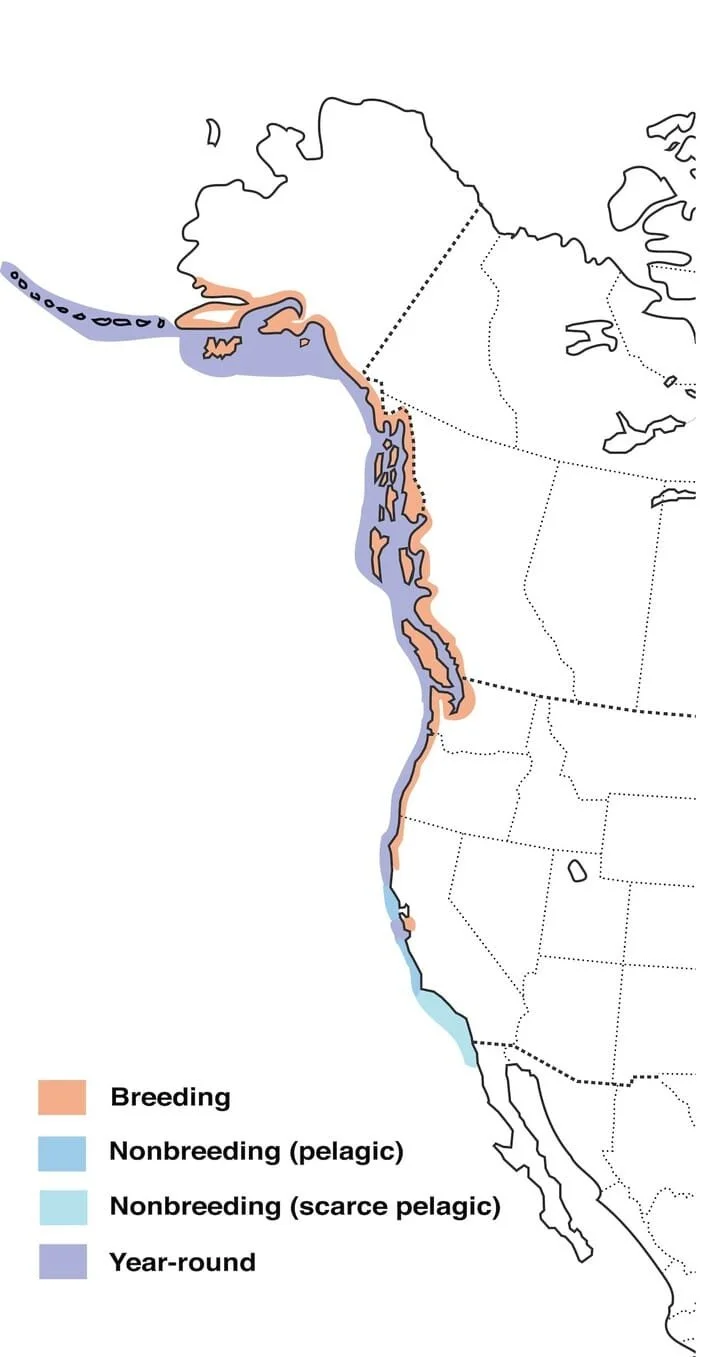
A frequent sight along Alaska’s southcentral coasts, Marbled Murrelets’ breeding range extends from Bristol Bay, Alaska, south to the Aleutian Archipelago, northeast to Cook Inlet, Kodiak Island, Kenai Peninsula, and Prince William Sound, throughout the Alexander Archipelago of Alaska, and through British Columbia, Washington, Oregon, and south to northern Monterey Bay in California. They winter throughout the breeding range.
The federally-listed portion of the Marbled Murrelets’ range extends from the Canadian border south to central California.
While at sea, Marbled Murrelets can generally be found near shorelines, feeding on fish and zooplankton. They’ve also been known to forage up to 180 miles offshore in the Gulf of Alaska.
Their breeding habitat has only come to light recently, with the discovery of the first nest in the 1970s. Marbled Murrelets seem to prefer moist, coastal coniferous forests, such as the Tongass and Chugach National Forests in Southcentral Alaska. They typically nest within a few miles of the ocean, though nests have been found up to 50 miles inland. They rely on old-growth forests, where large trees (some up to 800 years old!) provide the broad, mossy limbs that serve as their nesting platforms. Preferred trees include Douglas-fir, Alaska yellow cedar, western redcedar, western hemlock, mountain hemlock, Sitka spruce, and coast redwood. Rather than building a nest, Marbled Murrelets scrape away moss to create a bowl-shaped depression to help keep the single egg they lay and the resulting chick from rolling off the tree.
In some instances, Marbled Murrelets will also nest on the ground near the coast, usually on talus slopes, cliffs, or vegetated areas with alder or dwarf spruce trees.
LIFE HISTORY AND DIET
In early April, Marbled Murrelets make their way to coastal inlets and bays and begin their courting. Pairs swim side by side, extending their necks and pointing their bills up while producing soft calls, and frequently chase each other in flight. These courtship displays can continue year-round, and scientists believe that monogamous bonds may be maintained through the nonbreeding season.
A single egg is laid in a shallow depression in the moss on a tree limb. Both parents are involved in nesting and take turns incubating the egg for up to 30 days. They switch places at night to avoid predators and return to the ocean to find food. They continue to switch places for the first few days of their chick's life, and then both parents return to the sea to search for prey, returning only to supply the chick with meals, which consist of a single fish. The chick’s main protection during this time is its drab feathers, which help camouflage them. However, Common Ravens and Stellar’s Jays still pose a significant threat; there is about a 70 percent nest failure rate, with 90 percent of these losses resulting from predators.
Once the chick fledges, it flies alone, navigating over the forest to the ocean to join other Marbled Murrelets.
Marbled Murrelets eat small schooling forage fish, such as Capelin, Pacific Herring, and Pacific Sand Lance, as well as shrimp-like crustaceans. They dive for their prey, using their wings to “fly” underwater up to depths of 100 feet.
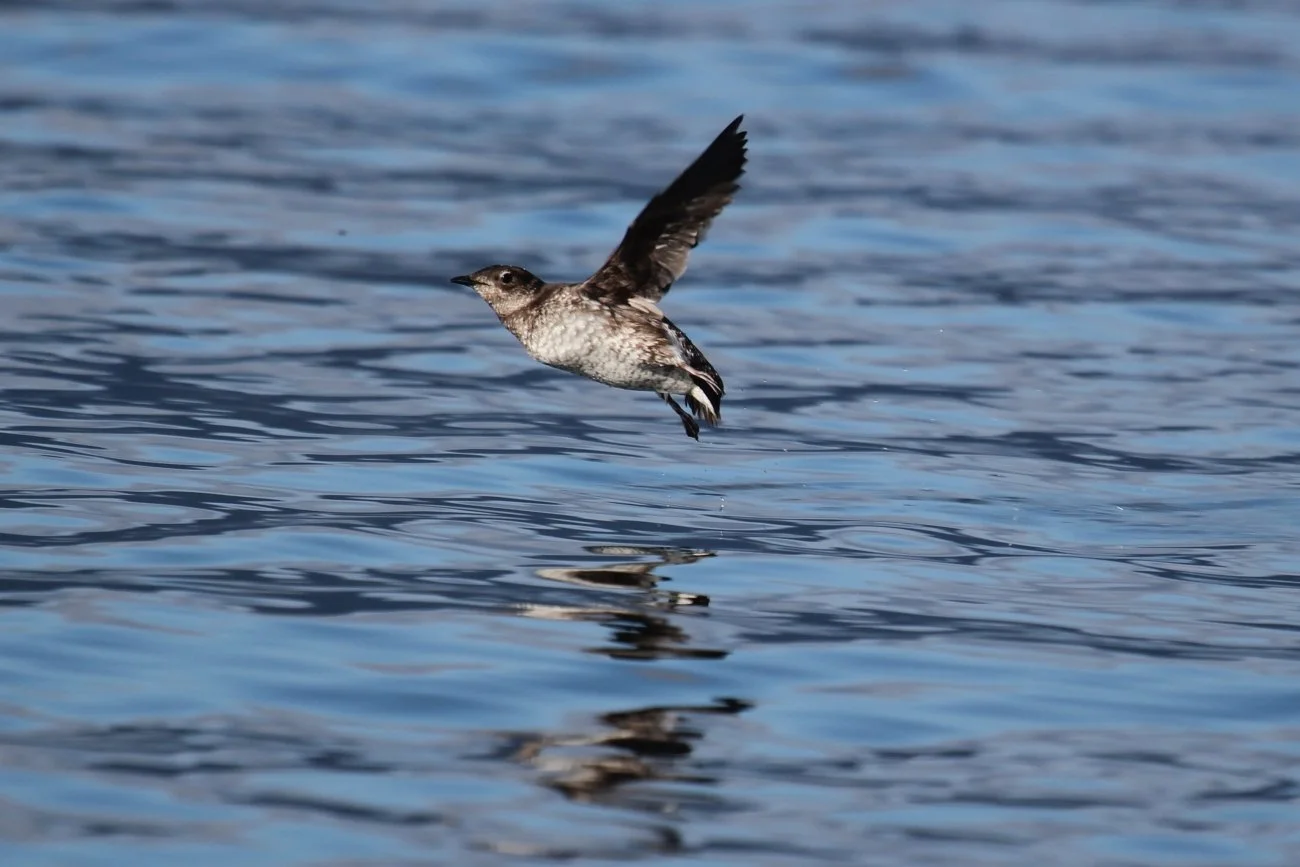
Photo credit: Robin Corcoran, USFWS.
THREATS/CONCERNS
In 2025, the State of the Birds report listed Marbled Murrelets as a Yellow Alert Tipping Point species, meaning that it has lost more than 50 percent of its population in the past 50 years but has relatively stable recent trends. They are listed as Threatened under the Endangered Species Act in Washington, Oregon, and California. Southern populations are declining at a rate of 4 to 7 percent a year across the southern portion of their range, and Marbled Murrelets could become extinct in California within the next 40 years.
While Alaska has much higher numbers of Marbled Murrelets, a 2007 US Geological Survey found that populations in Alaska have undergone a 71 percent decline since the early 1990’s, dropping from nearly a million birds to about 271,000.
Logging, particularly that done in old-growth forests, poses the most significant threat to the species, and large portions of their nesting habitat have already been cut down. Not only does logging destroy Murrelet nesting habitat, it also fragments the remaining habitat, making it easier for predators such as Ravens and Jays to access their nests.
Marbled Murrelets are also particularly vulnerable to oil spills and contamination because they forage near the shore, and are likely being affected by the changes occurring in the marine environment and forage fish due to climate change.
CULTURAL SIGNIFICANCE
The Marbled Murrelet, known as Ch’eet, is an important figure in Tlingit culture. The bird is represented in clan regalia and in Tlingit artwork, and is a significant crest for several clans.
