
Proposals to Watch for January Southeast Board of Game Meeting
The Board of Game proposals for the Southeast Region have been released and AWA is carefully combing through them so that we can best represent the needs of Alaska’s wildlife at the Wrangell Board of Game meeting in January.
What is the Board of Game?
The Board of Game (BOG) consists of seven members, each serving three years. There are no term limits. Members are appointed by the Governor and confirmed by the legislature.
The BOG makes decisions regarding game management in Alaska, including population and harvest objections and hunting regulations. These decisions include when to open and close seasons, areas for hunting and trapping, bag limits, methods and means, setting “policy and direction” for state wildlife management, allocative decisions, and deciding population objectives across the state.
The Alaska Department of Fish and Game (ADFG) is then responsible for enacting management based on those decisions.
The Proposal Process
Any Alaska resident can submit proposals to the Board of Game. Proposals are submitted and deliberated upon by region on a rotating basis, with a three-year cycle.
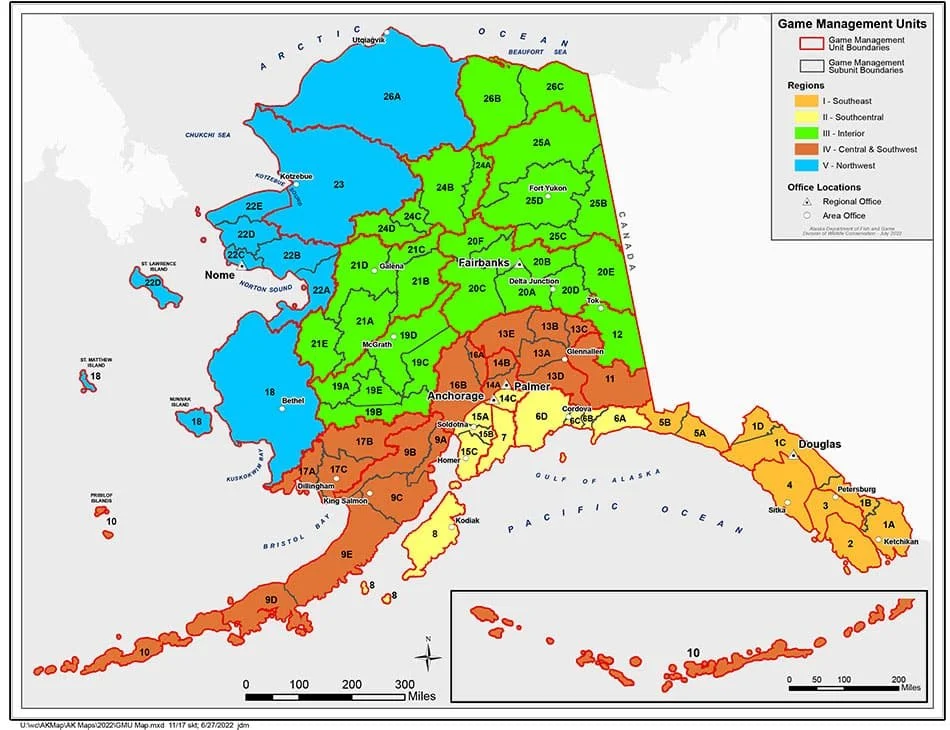
The Southeast game units are highlighted in orange.
In the spring, the BOG requested proposals, which are typically submitted in May the previous year for the January meeting. This is also when the BOG member confirmations are taken up by the legislature.
In the fall, the proposal book is released online. Advisory Committees (ACs), local groups that function as mini BOGs, review and vote on the proposals. Their votes are sent to the BOG and can have an impact on the Board’s decisions.
In December of this year, different departments, including ADFG, Alaska Wildlife Troopers, and the Department of Law, published most, if not all, of their comments on the proposals. These comments give valuable biological information and can provide a sense of what the departments feel about the proposals.
On January 9, public written comments are due on proposals. This is where you come in! Public comments can sway the BOG’s decisions on what proposals to approve or deny.
Between January 23 and 27, 2025, the Southeast Board Meeting will be held in Wrangell at The James and Elsie Nolan Center. There is a public comment period in the first few days, where written testimony may be given. Public comments are then closed and the BOG deliberates on all proposals. If you are interested in testifying, please contact nicole@akwildlife.org for support and questions.
How to Get Involved
There are several ways to get involved in the BOG proposal process. You can submit your own proposals, get involved with your local AC, or engage with the BOG nomination and confirmation process.
One of the easiest ways to get involved is to review proposals and submit written or oral testimony. Below, we’ll break down the proposals that AWA is concerned about, and give you information to submit your public comment by the January 9 deadline.
If you are interested in testifying at the January Board of Game meeting, please contact nicole@akwildlife.org for support and questions.
If you missed our Wildlife Wednesday on the BOG proposals, you can watch the recording below.
Proposals AWA is Watching
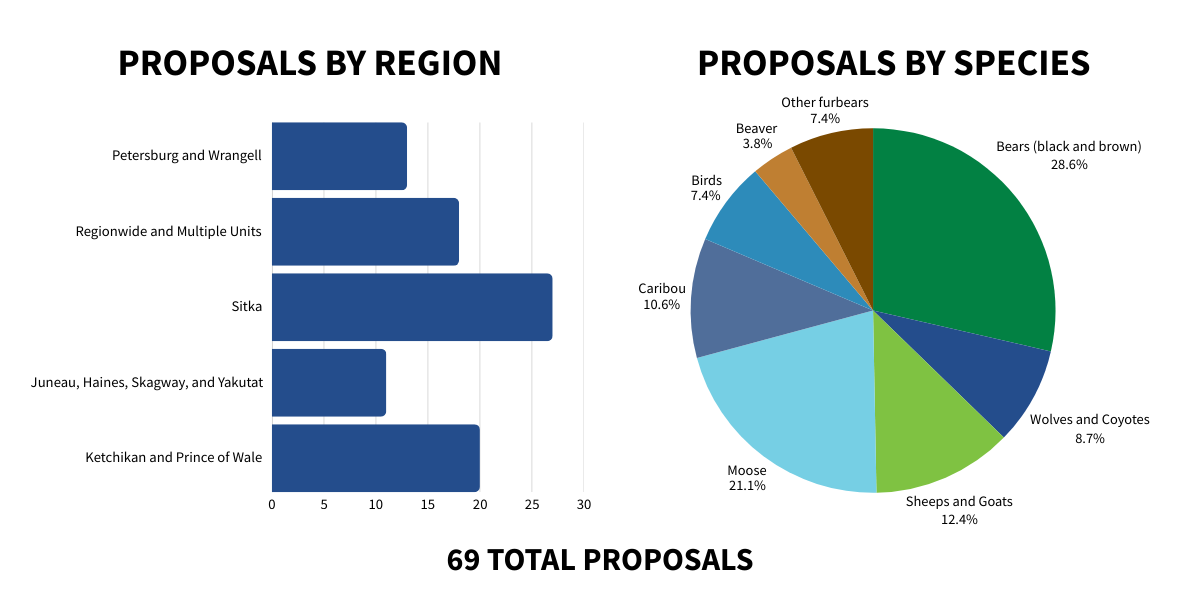
Sixty-nine proposals were submitted for the Southeast Region. See the graphs below for how they were divided up by region and species, and read on to learn which proposals we’re keeping at eye on.
Ketchikan and Prince of Wales
Proposal 48: Increase the Unit 2 wolf population objective from 150-200 wolves to 200-300 wolves.
AWA Supports: Proposal 48 deals with the genetically distinct Alexander Archipelago wolves, also known as coastal wolves, located on Prince of Wales Island. AWA strongly supports this proposal, as it is a near replica of our 2023 proposal 45, which requested to raise the population objective to 250-350 wolves and raise the threshold for closing the season when the wolf population reaches 200 wolves. That proposal failed 0-7 in 2023.
Alexander Archipelago wolf numbers reached a historic low in 2015, when the population estimate was only 89 wolves. Petitions to have them listed under the Endangered Species Act were denied. After more stringent trapping quotas led to a population rebound of 170, ADFG opened a two-month trapping season in the fall of 2019, with no limit on the number of wolves a trapper could kill, no limit on the number of trappers who could trap that season, and no limit on the number of wolves that could be taken throughout the season.
After that trapping season closed in March 2019, the Division of Wildlife Conservation released a report announcing that 165 wolves were killed during the season, not including illegal and unreported kills or natural mortality.
AWA filed a lawsuit, and since then has consistently requested that the wolf population objective be raised in Unit 2, including through our 2023 proposal, in wolf and deer management meetings, litigation, and in Board of Game proposals, all of which have been denied. ADFG now submits this proposal for the same reasons we have advocated for raising the population objective, including:
The Unit 2 wolf population is reproductively isolated and has a high degree of inbreeding, which increases the potential for inbreeding depression. Wolves in Southeast have been generally isolated from other North American wolf populations for thousands of years, with slowly declining genetic diversity. Within Southeast Alaska, the Unit 2 population is the most reproductively isolated, with the lowest genetic diversity and the highest degree of inbreeding. These conditions signal an increased level of risk for Unit 2 wolves.
The sustainable management of Unit 2 wolves requires consideration of both demographic and genetic factors; the number of wolves alone does not ensure a healthy population, as they must be genetically diverse.
In lieu of managing for baseline genetic diversity, ADFG could (and should) manage for a larger Unit 2 wolf population than the fall population objective of 150-200 wolves. We suggest 250-350 wolves to align with historic objectives for this population, but 200-300 is a good start to potentially ward off irreparable genetic bottlenecking.
Until new information is available, maintaining the current larger population size of Alexander Archipelago wolves is the best option to conserve existing genetic diversity and future management options. We appreciate the time and effort ADFG has recently given to understand this wolf population and, for the first time since the management plan was enacted, they are proposing to take a proactive, conservative approach to wolf management.
Proposal 54: Require identification tags to be attached to traps and snares in Unit 2.
AWA Supports: We generally support trap identification requirements, as many other states have found that the practice increases compliance with trapping regulations and discourages setting traps in irresponsible locations. Trap ID regulations also have precedence in Alaska.
We note that this would be challenging to enforce, given that Federal Subsistence Board (FSB) regulations do not require ID. However, FSB regulations are rarely ever more restrictive than the state. If the state enacted a regulation, it is more likely that FSB regs would follow. Finally, ID tags would not need to have the trapper’s information on the tag, but could use a number tied to their license available only to law enforcement.
Proposal 55: Prohibit the use of enhanced night vision and forward-looking infrared devices for taking furbearers in Unit 2.
Proposal 56: Prohibit the use of enhanced night vision and forward-looking infrared devices for taking furbearers in Unit 2 during any open deer season.
AWA Supports: AWA strongly opposed the regulation change that allows FLIR Statewide in 2025. A FLIR detects infrared radiation emitted from a heat source by using thermal or infrared technology to create a picture instead of amplifying visible light. FLIR devices make it possible to detect the heat of animals against cooler backgrounds and use advanced image correction technology. FLIR technology is available in handheld cameras and cameras that can be attached to a smartphone, goggles, or rifle scopes - they are widely available and easy to use.
Night vision devices and FLIR devices provide aid to trappers, allowing identification of and locating animals from far away through barriers such as snow and darkness, including big game. FLIR had only been legal in the Interior for one year when it was passed Statewide, so the impacts of the change are widely unknown (i.e., take of big game using FLIR), yet were hastily applied to the whole state. Almost every, if not all, of the Southeast ACs opposed the Statewide FLIR regulation, asking for a regional exemption due to poaching concerns.
We share the proposer’s concern that there is potential to abuse the use of FLIR or night vision to aid in the taking of big game, particularly in Unit 2, where the deer population is struggling.
Juneau, Haines, Skagway, and Yakutat
Proposals 31 and 32: Change the bag limit on the Chilkat Range in Unit 1C from one bear every 4 years to one bear every year.
Proposal 33: Change the bag limit in Unit 5 from 1 bear every 4 regulatory years to 1 bear every regulatory year.
AWA Opposes: All three of these proposals aim to change the bag limit of bears in the region. The proposals aim to increase the limit from one bear every four years to one bear every year. AWA is opposed to all three of these proposals for these reasons:
A liberalization of harvest like this would likely result in harvest levels above what is sustainable. Brown bear harvest along the Chilkat Range has been equal to or greater than the sustainable guideline harvest level for that population for 8 of the past 10 years.
Brown bear harvests have been low in the last 10 years in Units 5A and 5B, however ADFG attributes this to the local transporter not taking bear hunters out on hunts. A new air taxi in the area will likely increase success.
While the proponent suggests there is an increase in the brown bear population in this area, yet the department comments that the increased hunter participation and harvest from the most recent 5-year period do not indicate a growing brown bear population.
Petersburg and Wrangell
Proposal 66: Change the bag limit for brown bears in Unit 3 from one bear every 4 regulatory years to one bear every regulatory year.
AWA Opposes: Population estimates are not available for brown bears in Unit 3. Because of uncertainties about the size of the bear population (though it appears small), and in an effort to limit hunting pressure, the Unit 3 brown bear season is open only to Alaska residents.
Between 2015–2024, about half of the reported bear harvests from Unit 3 were outside of the current hunting season, due to the defense of life and property provision and poaching. Tripling the bag limit for this population, especially given the ratio of non-season bear kills, simply doesn’t make sense. Finally, the current Unit 3 harvest objective is to limit the annual harvest to no more than 3 bears. If this proposal is adopted, one person could legally harvest the entire unit's brown bear harvest objective in one year.

Thank you to all of our supporters and members who have helped us advocate for Alaska’s wildlife through the Board of Game process. Stay tuned for updates on which proposals passed and failed following the January meeting!
