

The Arctic Tern
The bird that flies around the world.
By Rayne Billings and Chelsey Cook.
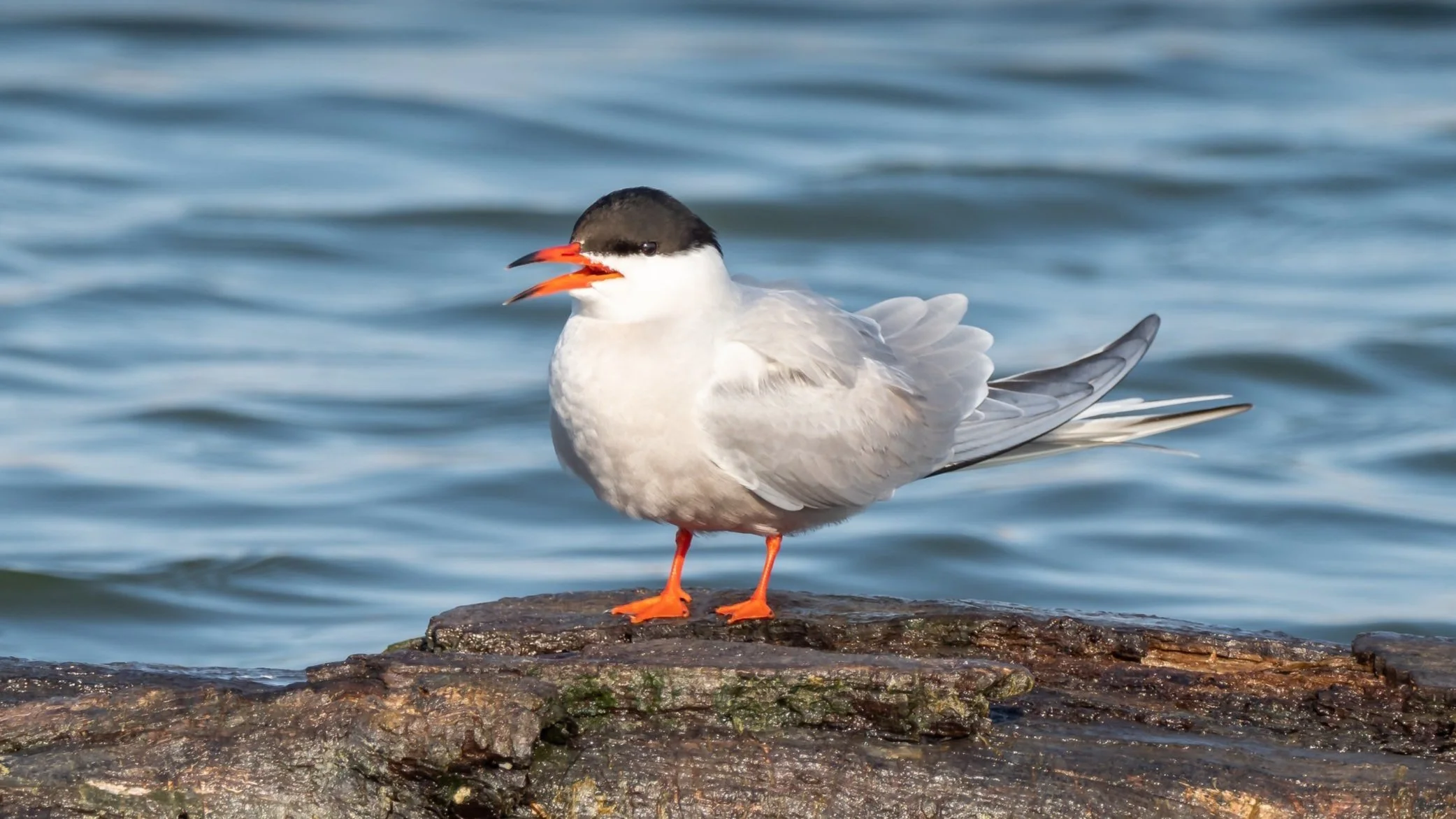
The Arctic Tern is a small coastal waterbird that has a dark forehead, a sharp beak, long pointed wings, and bright red legs and feet. They can be found in Alaska during the summer when they come to breed. They are often seen in coastal areas, where they will dive into the water to catch small fish. Arctic Terns have one of the longest migrations of any animal, which range from the Arctic to the Antarctic — a distance of, at minimum, 25,000 miles round-trip.
Although they are not currently endangered, they are at risk of losing large portions of their range due to global climate change and warming. It is believed that their range will continue shifting further north to combat this.
DID YOU KNOW…
Although Terns are waterbirds, they have very small webbed feet, meaning that they do not swim well. They are usually only in the water for as long as it takes to grab a bite of food.
Arctic Terns are thought to have the longest migration of any animal on Earth. In 2016, one Arctic Tern was recorded traveling 59,650 miles during their migration.
The oldest Arctic Tern was 34 years old!
Terns belong in the same taxonomic family as gulls and are one of the few birds that can hover in midair.

Photo credit: University of British Columbia/Mark Mallory
SCIENTIFIC AND COMMON NAMES
Sterna paradisaea; Kichyát (Tlingit).
GENERAL DESCRIPTION
Terns are a group of small, slender waterbirds that have gray wings and red webbed feet. There are three total species of terns in Alaska: the Arctic Tern, the Aleutian Tern, and the Caspian Tern. Arctic Terns are the most commonly seen throughout the state, with the other two species being rather rare.
Arctic Terns are smaller than gulls and thinly built with long, forked tails. Their beaks are sharp and pointed. Terns will often fly with their beaks pointed at a right angle towards the ground. On top of their forehead is a black patch of feathers that will be larger in size during the breeding season. Arctic Terns’ bills, feet, and legs are bright red. They have high-pitched, raspy calls. Arctic Terns are about a foot long and have a 30-inch wingspan.
RANGE and habitat
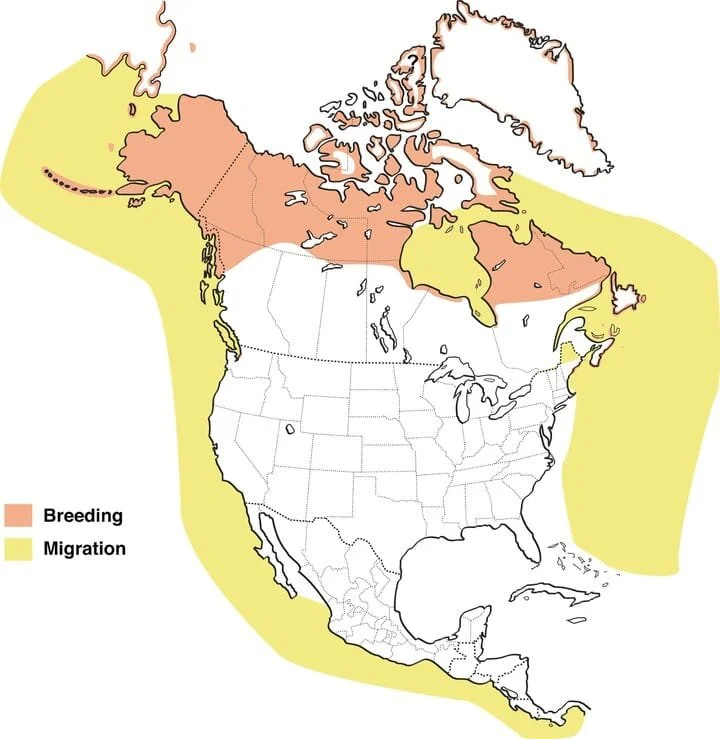
Map from All About Birds, Cornell Lab.
Arctic Terns are circumpolar. During the non-breeding season, they are completely ocean-dwelling, living over the open ocean at the edges of Antarctic sea ice.
In March, they head north to breed in coastal and subarctic regions throughout North America, including Alaska, New England, and Washington State, as well as Greenland, Iceland, northern Europe, and Asia. They have the largest breeding range of any Alaskan waterbird, and nest throughout the state of Alaska, from Utqiagvik down to Ketchikan.
Arctic Terns can be seen in a variety of places besides Alaska, such as South America, Western Europe, Iceland, Australia, New Zealand, and on Pacific Islands.
LIFE HISTORY and diet
In March, Arctic Terns begin leaving their wintering grounds and following a massive, winding migration route up the coasts of the Atlantic and Pacific Oceans as they head north to the Arctic. These migrations can cover up to 50,000+ miles round-trip and are some of the longest of any migratory bird on earth. They usually arrive at their summer breeding grounds in May and will begin nesting soon after. They build their nests near freshwater or saltwater on sandpits, beaches, and islands. When nesting inland, they build their nests on tundra or near ponds. Arctic Terns mate for life and will often form large breeding colonies.
They will usually lay two eggs, which are brown with light spots. The eggs hatch in about 23 days. The hatchlings will leave the nest soon after and hide in nearby bushes, where the parents feed them small fish. After about 25 days, the hatchlings will be able to fly. They will stay with their parents for another month.
Typically, Arctic Terns spend about three months in their breeding grounds before leaving for their southward migration towards Antarctica. While Terns are usually very noisy, just before migration begins, they will stay silent in a behavior known as “dread.” It is unknown as to why this happens. After dread is over, the colony will begin migration all at once. Most of the migration takes place over offshore waters and will usually last a few months.

Arctic Terns migrate to stay where it is summer. While it is winter in the Northern Hemisphere, it is summer in the Southern Hemisphere. Sunlight in the summer allows them to easily find the small fish that they eat. The Arctic Tern may experience more daylight than any other animal on the planet due to their migration patterns.
Arctic Terns are so lightweight that they can utilize ocean breezes to carry them long distances without flapping their wings. They can sleep and eat while gliding. It is commonly assumed that the Terns utilize “unihemispheric sleep,” or the practice of sleeping with one half of the brain at a time. However, it is also possible that they do not sleep or sleep for very short periods of time during migration. If Arctic Terns did not need to stop and eat, they would be able to fly 1,000 miles a day.
Arctic Terns do not fly in a straight path from the Arctic to the Antarctic. Instead, they will regularly stray off course in search of the best weather and the best food. Although they will usually return to the same nesting ground each year, occasionally a tern will go to a new spot. For example, it has been recorded that some Arctic terns from Greenland were later spotted in Australia.
Arctic Terns have long lifespans and typically live to be between 20 and 30 years old. By the end of their life, an average Arctic Tern may have flown 1.5 million miles, the equivalent of traveling around the Earth 60 times.
Watch the video below to see some Arctic Tern migration patterns.
Arctic terns primarily eat small fish, such as herring. They will also eat small invertebrates and insects. Rarely, they will eat berries.
They forage by hovering over the water, then plunging down and grabbing a fish in their beak. They are not strong swimmers and will typically only stay in the water for as long as it takes to grab a fish.
THREATS and CONCERNS
Globally, Arctic Tern populations appear to be stable. However, they can be difficult to observe because their range is so remote. Their long life span could also mask population declines.
One of the largest potential threats facing the Arctic Tern is climate change in the Arctic and Antarctic. With increasing global temperatures, the Arctic tern’s range could be decreased by 48 percent. Their range will likely continue shifting further north to combat overall warming temperatures.
In the late nineteenth century, Arctic Terns were targeted for the feather trade, which caused populations to decline. Most populations recovered following the enactment of the Migratory Bird Treaty Act in 1918.
Other threats to Arctic Terns include human disturbance at colonies, predation of eggs and hatchlings, and reductions of forage fish populations.
CULTURAL SIGNIFICANCE
Inuit and Inupiat eat Arctic Terns eggs. The eggs are mostly boiled, but can also be fried or eaten raw. Most of the egg collecting happens during a two-week window in early July. They rely on the birds’ presence to serve as indicators of environmental conditions — the presence of Arctic terns in early summer indicates that warm weather is coming. Arctic terns diving at sea can also be an indicator of good fishing areas.

