
The Dall Sheep
The Boldly Yet Functionally Accessorized Sheep
By Yumeko Ziegler and Chelsey Cook
Dall sheep are found throughout the mountain ranges of Alaska, where they live in alpine meadows, open ridges, and steep, rugged slopes. Like mountain goats, they have white coats that help them blend into their snowy surroundings, but they can be distinguished from mountain goats in part by their horns. Like mountain goats, both male and female Dall sheep have horns; however, while mountain goats have short, sharp black horns, Dall sheep have lighter, curved horns. Dall sheep rams can grow dramatically, beautifully curled horns.
Dall sheep are especially well known in the Brooks Range and Alaska Range, and can be seen at popular wildlife viewing areas, including the Dalton Highway, Atigun Pass, and Galbraith Lake.
Dall sheep use steep, rocky terrain to escape predators. Their populations in Alaska are overall considered stable, however there have been severe regional declines in areas such as the Chugach and Brooks Range of 20 to 70% since the 1990s, largely due to environmental conditions. Severe winters, summer drought, low lamb survival, and predation can all affect populations. Wolves, coyotes, golden eagles, wolverines, and brown bears are among their predators
DID YOU KNOW…
You can estimate a Dall sheep's age by its horns! Like trees, horns grow in seasonal spurts, creating growth rings called annuli. These rings can help determine a sheep's age.
Rams use their massive horns to establish social order. During clashes, rams slam their horns together in displays of strength.
Their rugged habitat can make them difficult to hunt. Dall sheep live in remote alpine terrain that is challenging to access. ADF&G notes that this remoteness and the area's unsuitability for human use have historically protected sheep from many human impacts. Hunting does occur, however, and sheep harvest is actively managed in Alaska.
Dall sheep are named after William Healey Dall, an American naturalist and explorer who studied and collected specimens throughout Alaska in the 1800s.
They are the only wild sheep native to Alaska!
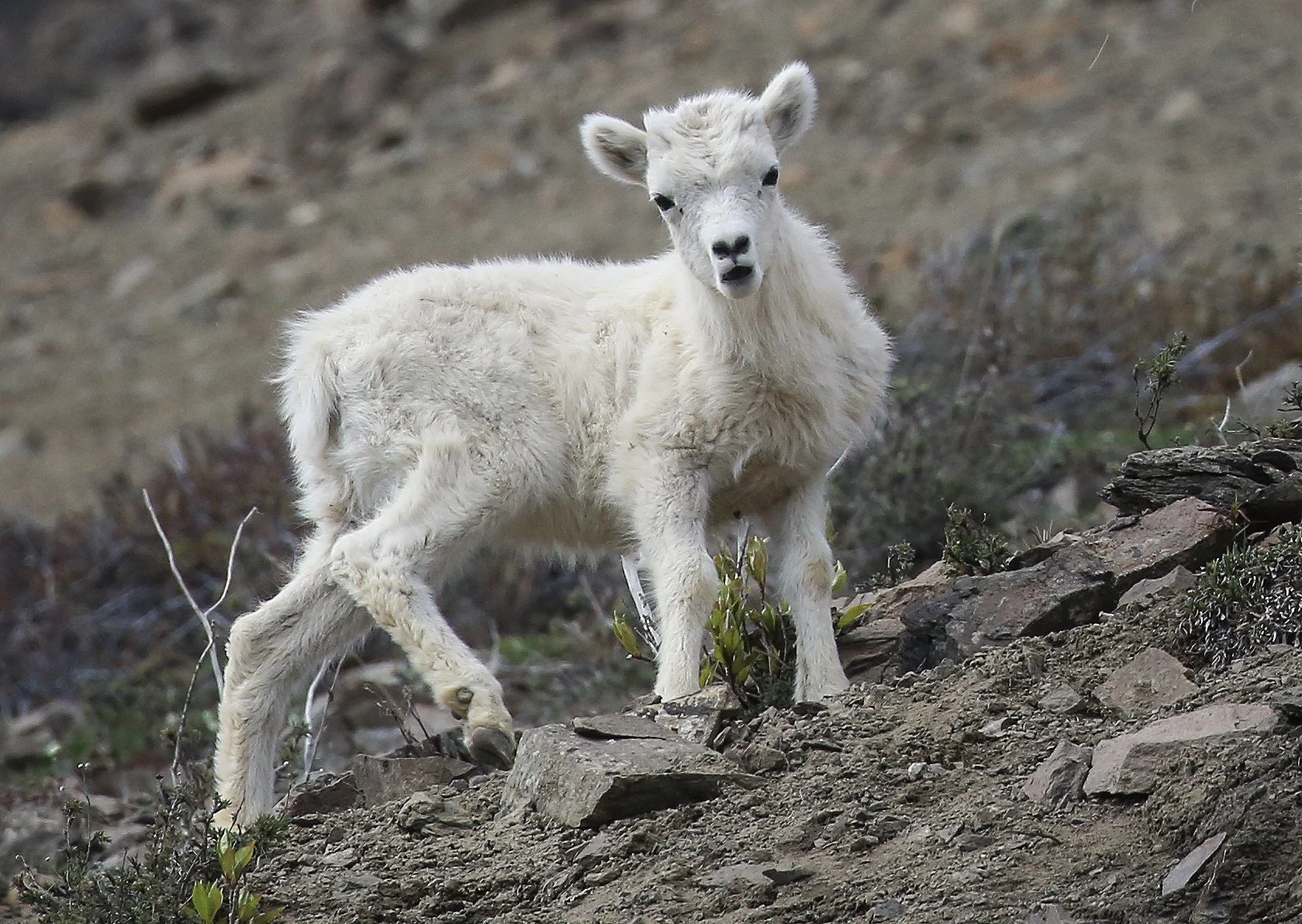
Photo credit: Emily Mesner.
SCIENTIFIC AND COMMON NAMES
Ovis dalli dalli, Dall Sheep, also referred to as thinhorn sheep or Dall’s sheep.
GENERAL DESCRIPTION
Dall sheep are sexually dimorphic, meaning males and females have noticeable physical differences. Both rams (males) and ewes (females) have horns, but rams develop much larger, more dramatically curled horns. Young rams look similar to ewes until around three years old, when their horns begin growing more rapidly and becoming thicker and more curled.
Dall sheep horns grow seasonally, slowing or stopping in late fall and winter. This creates annual growth rings, called annuli, which can be counted to estimate a sheep’s age.
Their thick, off-white coats help them survive Alaska’s harsh alpine winters. Their winter wool can grow more than two inches thick, providing insulation against extreme cold. Adult rams typically weigh around 160 to 180 pounds, while ewes weigh about 100–110 pounds. During winter, adults may lose up to 16% of their body mass, while young sheep can lose considerably more.
RANGE

Map courtesy of ADFG
Dall sheep are native to Alaska and western Canada and are associated with rugged, mountainous landscapes. They are found throughout many of Alaska’s mountain ranges, including the Brooks, Alaska, Chugach, Kenai, and Wrangell Mountains. They are also found in parts of the Talkeetna Mountains and other smaller mountain ranges.
Dall sheep typically live in alpine and subalpine habitats, often above or near the tree line. They prefer steep, rocky slopes, ridges, cliffs, and open mountain meadows where they can feed and move easily across rugged terrain. These steep areas also provide important escape habitat from predators.
In winter, Dall sheep seek out wind-swept slopes and ridges where strong winds keep snow shallow or expose patches of vegetation. This allows them to reach grasses, sedges, lichens, and other plants beneath the snow. During summer, they take advantage of the abundant vegetation found in alpine meadows and move to higher elevations as conditions change.
Some well-known areas for viewing Dall sheep include the Dalton Highway and Atigun Pass, the Alaska Range, and the Kenai and Chugach Mountains. Their preference for high, rugged terrain means they can be challenging to spot, but groups of white sheep are often visible against the dark rock of the mountains.
LIFE HISTORY and Diet
Dall sheep have a well-developed social system. Ewes live in groups with other ewes and their lambs, while rams often form separate groups called bands. Ewes generally get along well, while rams compete for dominance through displays and fights. Rams and ewes primarily come together during the breeding season in late November and early December.
Rams can breed as young as 18 months, however it is more common to have to wait until they reach social dominance and adult size at 5-7 years old. Ewes can begin breeding around three years old. After about 175 days of gestation, ewes typically give birth to one lamb in late May or early June. Twins are possible but rare.
Because lambs are most vulnerable during their first few weeks, ewes often give birth in steep, rugged areas where they can stay hidden from predators. Lambs can stand within minutes of birth and usually travel with their mothers within a day. They begin eating vegetation within a few weeks and are typically weaned at 3–5 months.
Dall sheep are herbivores, and their diet changes with the seasons. In summer, they eat grasses, sedges, forbs, lichens, and mosses. Winter brings fewer food options, so they rely on vegetation that remains accessible beneath the snow. They also visit mineral licks to obtain salt and other minerals, sometimes gathering with sheep from other groups.
Dall sheep typically live around 12 years, although some can live considerably longer.
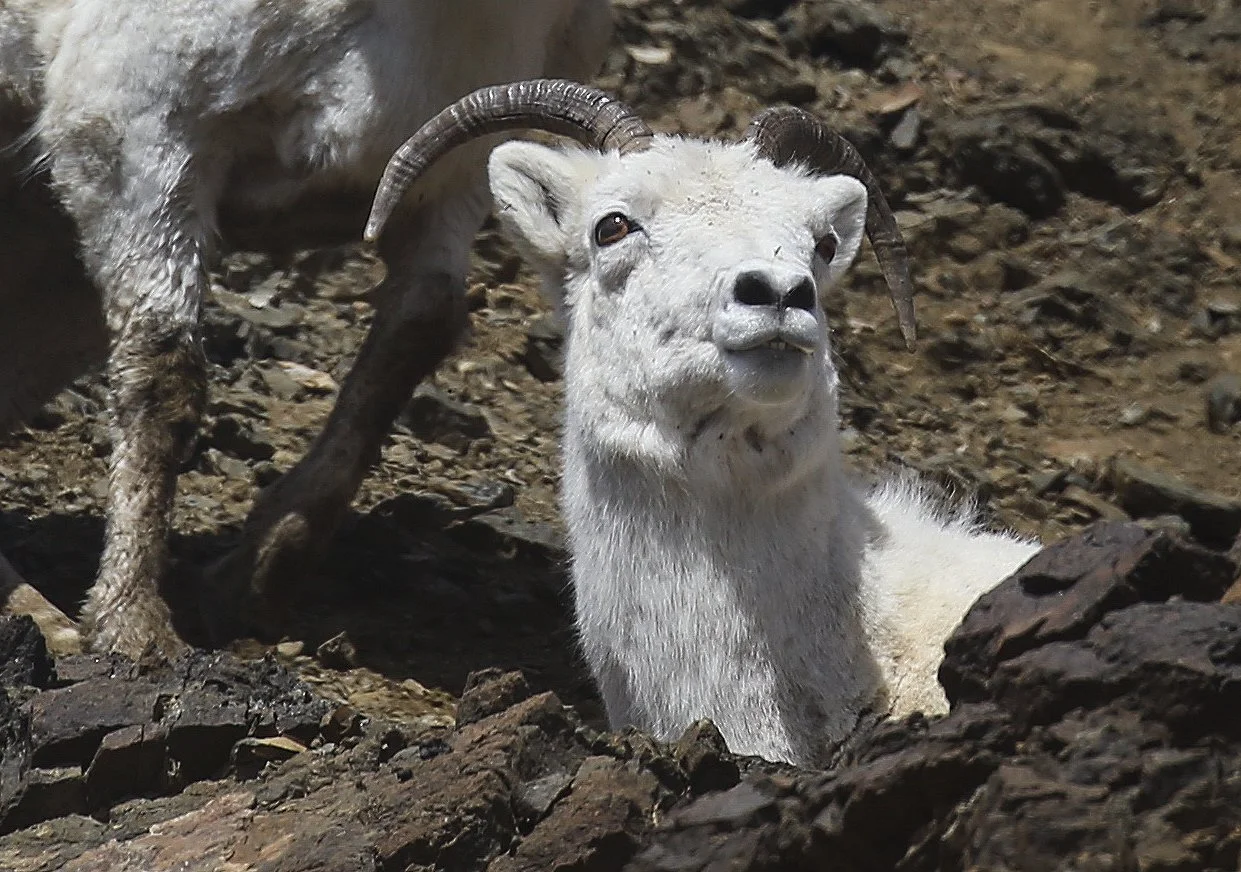
Photo credit: Emily Mesner
Threats and COncerns
Dall sheep populations in Alaska are generally considered healthy, but they are very sensitive to changes in weather and environmental conditions. Severe winters, deep snow, freezing rain, and late springs can make it difficult for sheep to reach food and can be especially hard on lambs. Research in Alaska has linked late springs and prolonged snow cover to lower lamb survival and population declines. Avalanches also can pose a significant risk to Dall sheep.
Predation by wolves, coyotes, golden eagles, wolverines, and bears can also affect sheep, particularly young lambs. Hunting is another source of mortality and is regulated in Alaska to help manage populations. As human use of alpine areas increases, disturbance and habitat changes could also become greater concerns for Dall sheep.
Overall, Dall sheep are well adapted to Alaska's rugged mountains, but their dependence on specific alpine habitat makes them sensitive to significant changes in weather and environmental conditions.
CULTURAL SIGNIFICANCE
Dall sheep have long been an important part of Indigenous life in Alaska, providing food, clothing, tools, and other materials. Archaeological and historical records document Dall sheep hunting by Alaska Native peoples for generations. In the Wrangell Mountains, for example, Ahtna and Upper Tanana Athabascan communities traditionally hunted sheep as part of their seasonal rounds, particularly in late summer and fall.
Dall sheep meat was highly valued and was preserved by methods including drying and smoking. Sheep hides were also used to make warm clothing, mittens, socks, sleeping bags, blankets, and coat linings. Their horns could be carved into spoons and other useful objects.
Dall sheep continue to be important for subsistence in some Alaska communities today. ADF&G reports that communities in the Brooks Range hunt Dall sheep for subsistence, with winter travel by snowmachine sometimes making it easier to reach sheep and transport meat.
Dall sheep are more than a game animal in Alaska. Their long history of use reflects the knowledge, skills, and traditions that Alaska Native communities have developed around living in the state's mountainous landscapes.
