

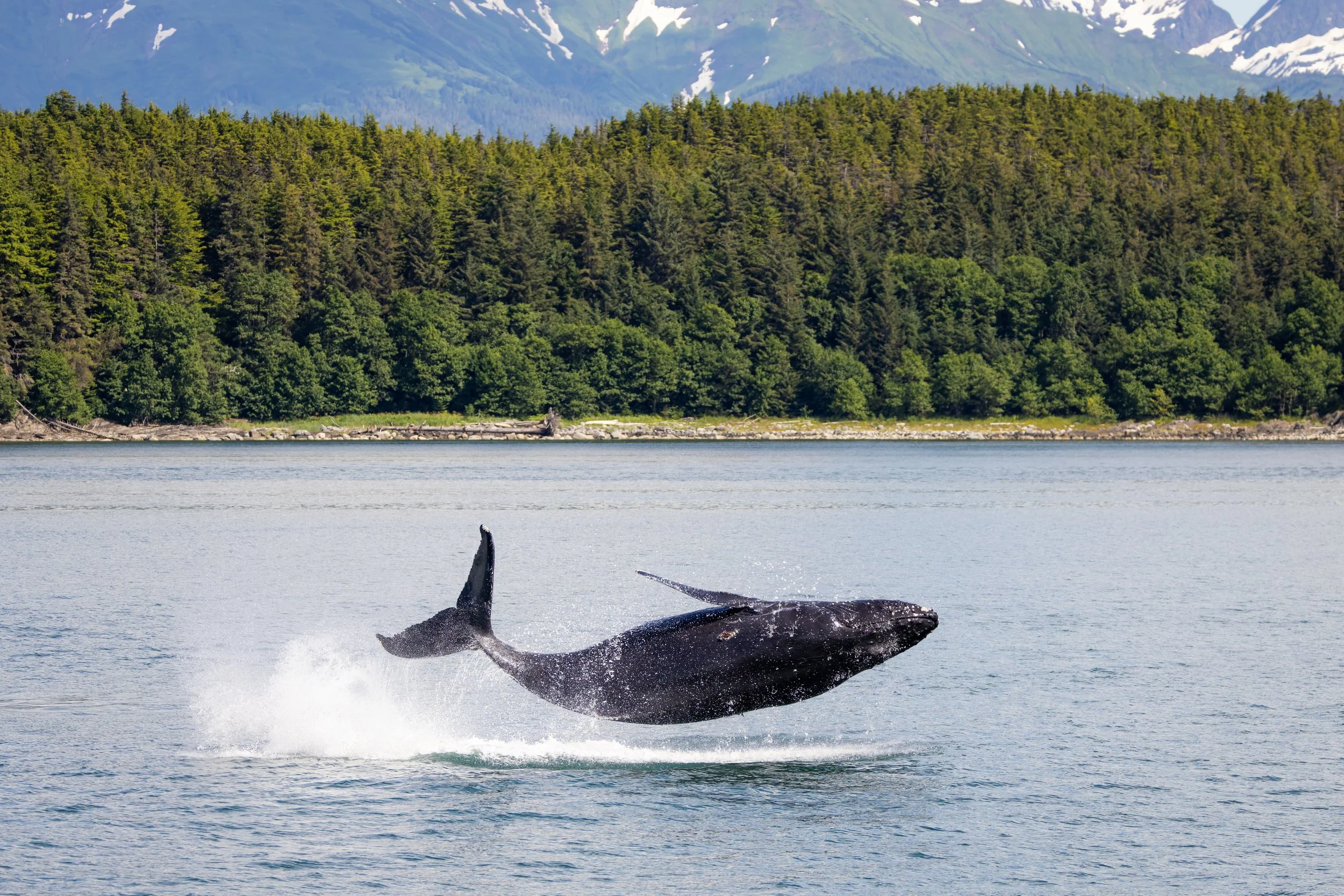
Photo credit: Richard Lovelock.
The Humpback Whale
A Whale with a Song
By Julia Illar
The humpback whale is a large cetacean known for its vocalizations and complex song used for mating. Humpbacks spend time in Alaska during the spring, summer, and fall to feed, and then migrate up to 3,000 miles to warmer waters in Hawaii, Mexico, and Japan to breed, calve, and nurse their young.
These whales can have elaborate bubble netting and diving displays, making them a popular whale to watch.
DID YOU KNOW…
Humpbacks were hunted commercially until the mid-1900’s, and their population crashed by an estimated 90% or more in some regions until commercial hunting was banned.
Humpbacks feed on krill and small fish. Using their baleen plates as a sieve, they filter water through the baleen, all while keeping the fish in their mouths.
Females produce a calf every 2 to 3 years, and gestation lasts 11 months.
Calves are not thought to form long-term associations with their mothers, but they are often found in the same breeding and feeding areas as them.

Photo credit: NOAA Fisheries
SCIENTIFIC AND COMMON NAMES
Megaptera novaeangliae, meaning “big winged” and “New England”, for where European whalers first encountered them.
GENERAL DESCRIPTION
Humpback whales are known for their enormous size, long wing-like pectoral fins, and spectacular breaches. Adults can reach up to 60 feet and weigh as much as 40 tons - the equivalent of four school buses! Their bodies are dark gray to black, with distinctive white markings on the underside of their flukes (tails), which can be used to identify individual whales. They are a baleen whale, and have flexible plates in their mouths that act as a filter-feeding system. Humpbacks use the row of baleen to push water out of their mouth while keeping krill and other food items inside.
Humpbacks spend their summers in Alaska’s coastal waters, where they feed on small fish and krill. They are commonly found throughout Southeast Alaska, the Gulf of Alaska, Prince William Sound, and parts of Southcentral Alaska. Each fall, most migrate thousands of miles to warmer tropical waters in Hawaii, Mexico, or Japan to breed, calve, and nurse before returning to Alaska the following spring.
RANGE
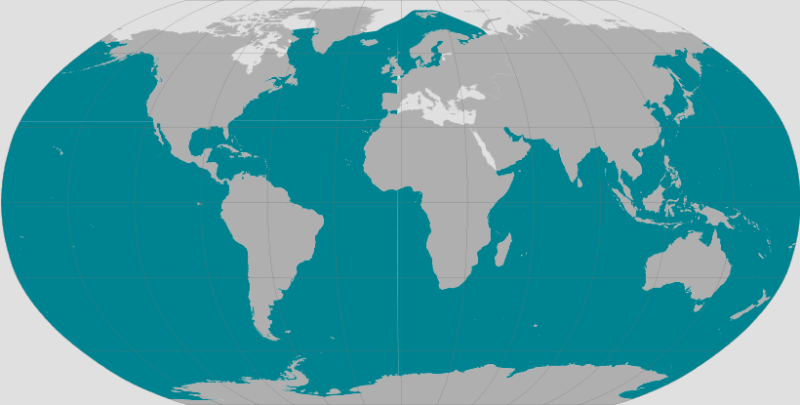
Map from NOAA Fisherie
The humpback whale lives and migrates throughout many of the world’s oceans. In Alaska, humpback whales travel through Kachemak Bay, Prince William Sound, Southeast Alaska, and throughout most of the waters surrounding the state. They can also be found along the East Coast of the United States and in waters along Canada, Hawaii, Japan, Central America, and Mexico. These whales travel throughout most of the world’s oceans aside from polar regions.
While females calve, they prefer shallow and warm waters near coastal shores or offshore reef systems. When not calving, humpbacks can be found following their food sources. Their prey are often found in cold, nutritionally-productive waters.
Humpback whales are known to seasonally migrate and can sometimes travel 5,000 miles from their summer feeding grounds to their tropical calving areas. In some cases, humpbacks migrating from Alaska to Hawaii have completed the 3,000-mile trip in nearly 28 days!
Watch a video of migrating Humpback whales making their way from cold Antarctic waters to warmer Australia waters…
Threats/Concerns
Humpback whales are no longer hunted in the U.S. and are protected under the Endangered Species Act and the Marine Mammal Protection Act. They also have now been protected worldwide from commercial whaling with the exception of some select countries. Humpbacks used to be whaled regularly for oil and baleen. They now face threats like entanglement in fishing gear, vessel strikes, harassment from boats, and ocean noise or sound pollution.
Vessel strikes are common in areas where humpbacks are in coastal regions with heavy ship traffic. Entanglement can be caused by many types of gear, such as moorings, gillnets, pots, and traps. These items can remain on the whale and cause fatigue, severe injury, and compromised movement.
Boater harassment can stress and confuse humpbacks trying to feed or migrate. Because they are active whales, they are popular for whale watching and other tourist attractions. Viewing guidelines are in place in many countries and states in an attempt to prevent boater harassment.
LIFE HISTORY
Humpbacks reach sexual maturity between 4 and 10 years of age. Females tend to have a calf every 2 to 3 years after reaching sexual maturity and mating. Gestation lasts around 11 months and calves are born 13 to 16 feet long.
Calves are born in warm, tropical waters. Mothers migrate during the winter to warm waters to calve and/or mate. Soon afterwards, mothers and their calves make their way to more nutrient-rich waters (typically colder ones in lower latitudes), during the summer months. Calves will nurse from their mothers for about a year before being weaned. It is not believed that there are long term mother and calf associations, but they are often found in the same feeding and breeding areas as one another. During the nursing stage, mothers are protective of their young.
Humpback whales are known for their large range of noises as well as squeaks, squeals, and grunts. Only male humpback whales sing, similar to how male songbirds sing. It is believed that this observation in humpback whales is a mating behavior to attract a female, although much of this behavior is still being studied. There are many theories as to what this singing behavior could mean. Some theories include the idea that the song functions as an index of association between males. This could help individuals to determine their cooperativeness and if they are competing for females. The song is unique and extremely complex.
Humpback whales are also known for their active breaching and surface behaviors and are known to be social cetaceans. “Breaching” is when a whale propels itself up and out of the water, with more than half of its body leaving the ocean. Again, there are many theories as to why humpbacks are engaging in this behavior. Some theories as to why this occurs include: communication to other whales, dislodging of barnacles, or even just out of enjoyment. They could also be sloughing off dead skin, or it could be a behavior to deter predators like killer whales. It is also thought that behaviors like “tail lobbing” (where a humpback smacks its flukes against the surface of the water) could be to stun prey or to scare off predators. “Pec slapping” is where humpback whales take their large pectoral fins and slap them against the surface of the water. The purpose of this behavior also has many theories, but some include using it as a means of communication with others as well as a way to stun prey.

Photo courtesy of Whale SENSE
Check out this video of a humpback and her calf…
DIET
Humpback whales eat a diet rich in small crustaceans. This consists of mostly krill, which are small shrimp-like crustaceans. They also feed on small fish and are known to even eat squid.
Humpbacks are known as having diverse diets and tend to follow the food source in lower latitudes. They use many techniques to hunt their prey. These consist of methods like using “bubble nets” or slapping the water using their pectoral fins to stun prey. Bubble-net feeding is where humpbacks will swim below their prey and expel small amounts of air through their blowholes. This creates a curtain of rising bubbles that travels upwards through the water and condenses their prey by pushing them towards the surface of the water. From there, the whales lunge upward and use their baleen to filter out water while swallowing the trapped fish.
Watch a humpback use bubble-net feeding to capture prey!
Threats and Concerns
Current threats to the humpback whale include:
Vessel Strikes
Climate Change
Entanglement in Fishing Gear
Vessel-Based Harassment
CULTURAL SIGNIFICANCE
Humpback whales were originally hunted by some indigenous groups in Alaska. Namely, the Aleut culture would use a two-person kayak, also called a “umiak”, and a harpoon to hunt humpbacks. Baleen was sometimes used for holding waterfowl snares open, and whale bone was used to split wood. As there were increasing concerns with whaling and the decrease of the humpback population, hunting and consumption of the whale dwindled.
