
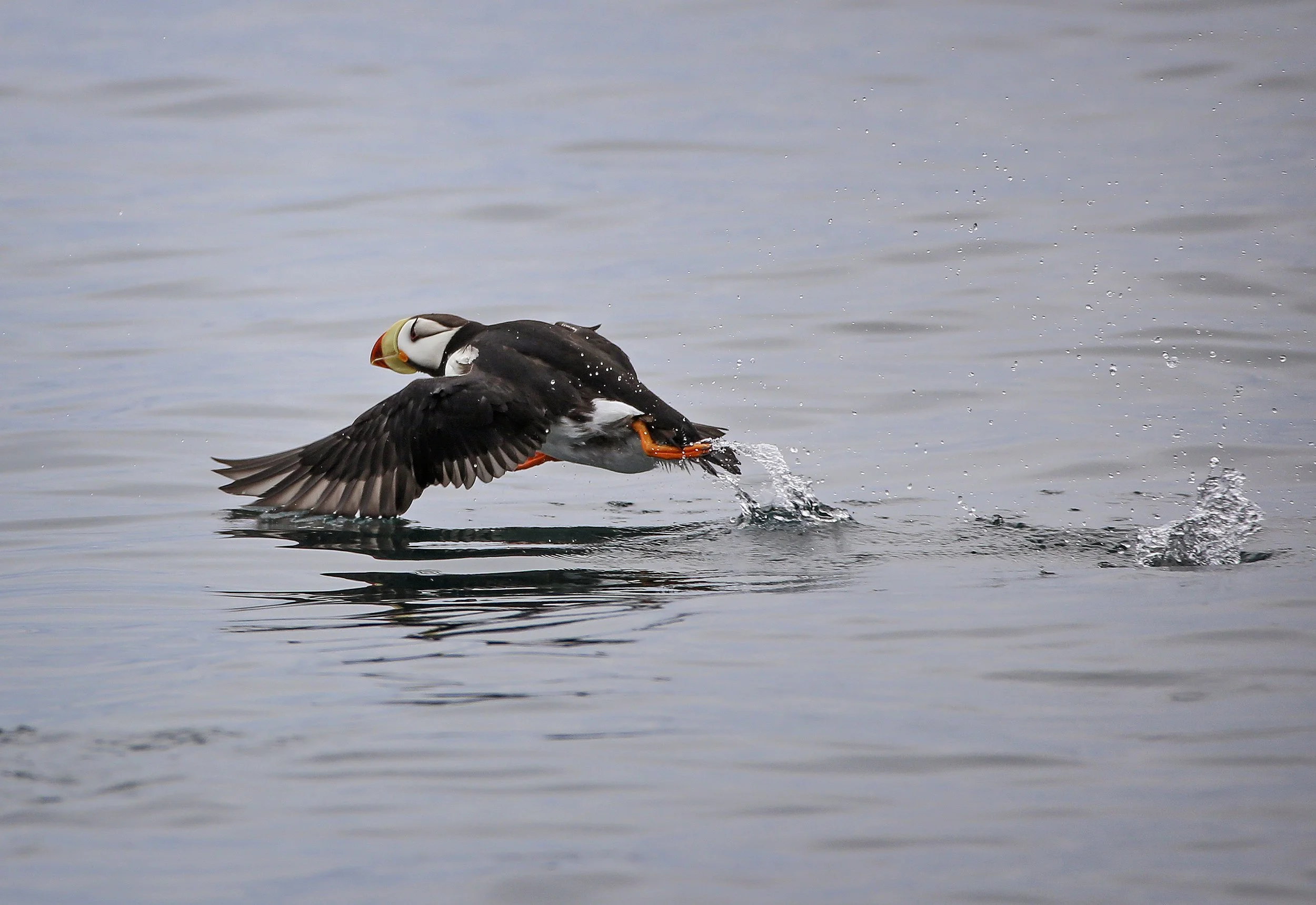
Photo credit: Emily Mesner.
The Horned Puffin
By Yumeko Ziegler and Chelsey Cook
The horned puffin is one of the most iconic birds in Alaska. The black-and-white seabird features a striking orange-and-yellow bill during the mating season, as well as fleshy spikes above the eyes, their “horns”. Affectionately dubbed Quengacuar(aq) in Scammon Bay, meaning “little nose,” horned puffins have a special place in Alaskan culture.
Horned puffins are seabirds, so they spend most of their time in the open water. However, they nest in colonies on rocky cliffs and islands, often in crevices, among boulders, or on rocky slopes, and are easily identified by their white bellies and their bright orange and yellow bills. They can be found “flying” underwater after prey, using their wings to dive as deep as 250 feet underwater.
Horned puffins are not threatened or endangered; however, they’re facing increasing dangers from changes in ocean temperatures and food availability, bycatch in commercial fishing nets, and plastic ingestion.
DID YOU KNoW…
Horned puffins were called “sea parrots” by early sailors.
Baby puffins are called “pufflings”.
One puffin was observed carrying 65 fish in her bill for her pufflings!
Horned puffins bond for life and rub bills as a sign of affection.
After breeding season, horned puffins will shed the outer, colorful plates of their bills as well as the horns above their eyes.
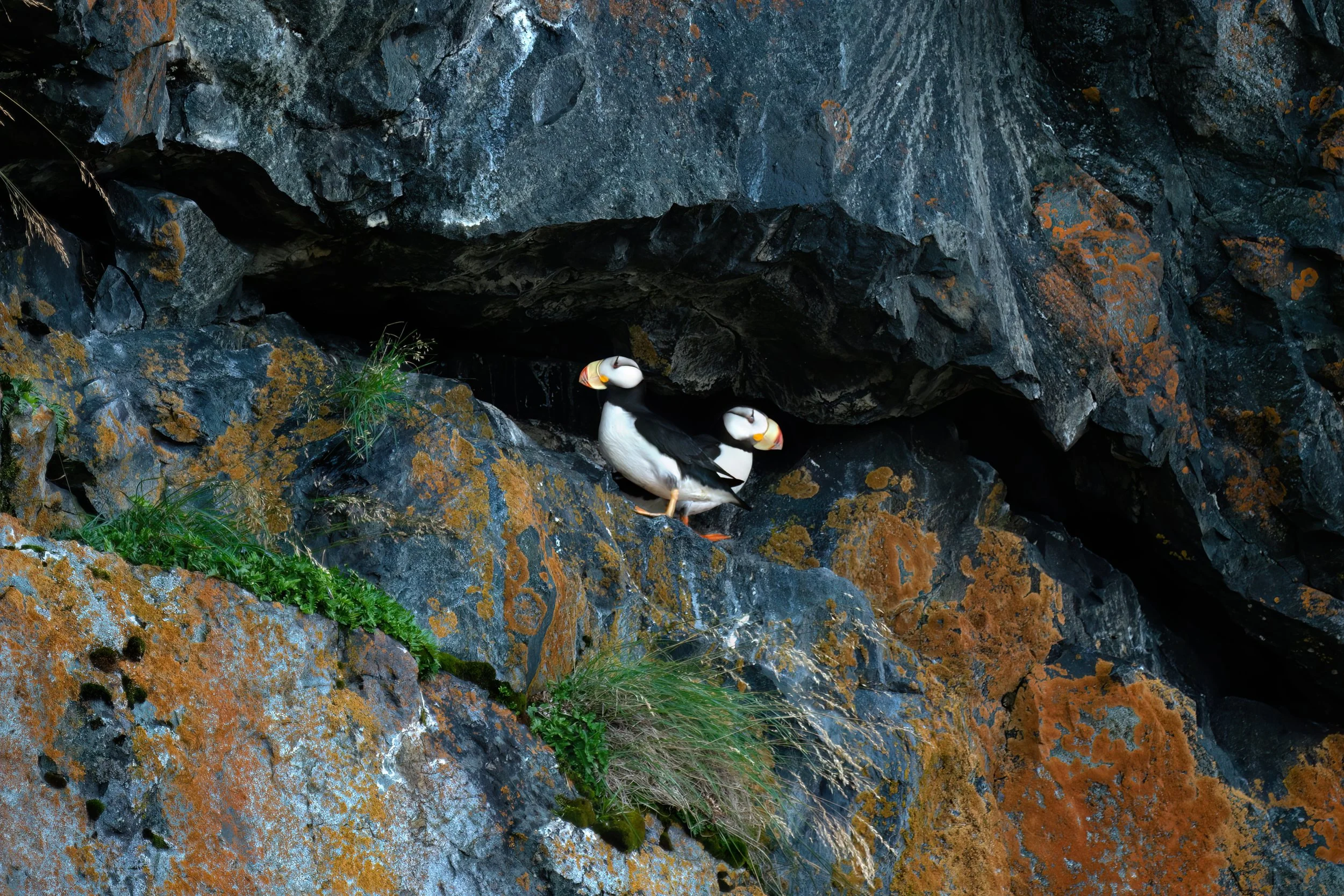
Photo credit: Lisa Hupp, USFWS.
SCIENTIFIC AND COMMON NAMES
Fratercula corniculata, meaning “horned little brother." Also known as Qategarpak in Yupik, meaning “big white breast,” and Quengacuar(aq) in Scammon Bay, meaning “little nose.” Known as Ngaq’ngaaq in Sugt’stun.
GENERAL DESCRIPTION
Horned puffins have a large colorful bill, stout bodies, white bellies, short wings, and orange or red webbed feet placed far back on their bodies. Breeding adults have iconic “horns,” which are small fleshy spikes that extend above their eyes. Compared to the breeding adults, immature or non-breeding puffins have grey faces and a smaller bill. Adults are about 14 inches long and weigh about 1.25 pounds.
Horned puffins have short wings, making their flight appear awkward, requiring a run on the ground to push themselves aloft. Because takeoff is difficult for them, horned puffins fly close to the water initially, sometimes beating the water with their wings to propel themselves up.
They compensate for this by being nimble walkers and great swimmers. Horned puffins use their wings to “fly” underwater, using their webbed feet to change directions, generally going 100 feet deep but are capable of going 250 feet deep.
RANGE and Habitat

Map courtesy of The Cornell Lab
Horned puffins are found in the North Pacific Ocean from British Columbia (where they are uncommon) to Alaska, and southwest to the Sea of Okhotsk and the Kuril Islands near Russia. They spend most of their lives on the open sea, and they only visit land to breed in May or later in northern areas. Normally, horned puffins are relatively close to land, but sometimes their commute is over 60 miles to reach productive foraging grounds in the Gulf of Alaska and Bering Sea. After nesting season ends, they return to the central North Pacific.
When on land, they live on coastal islands, rocky cliffs, and steep slopes. Rather than digging burrows like other puffin species, horned puffins typically lay their single egg on the ground.
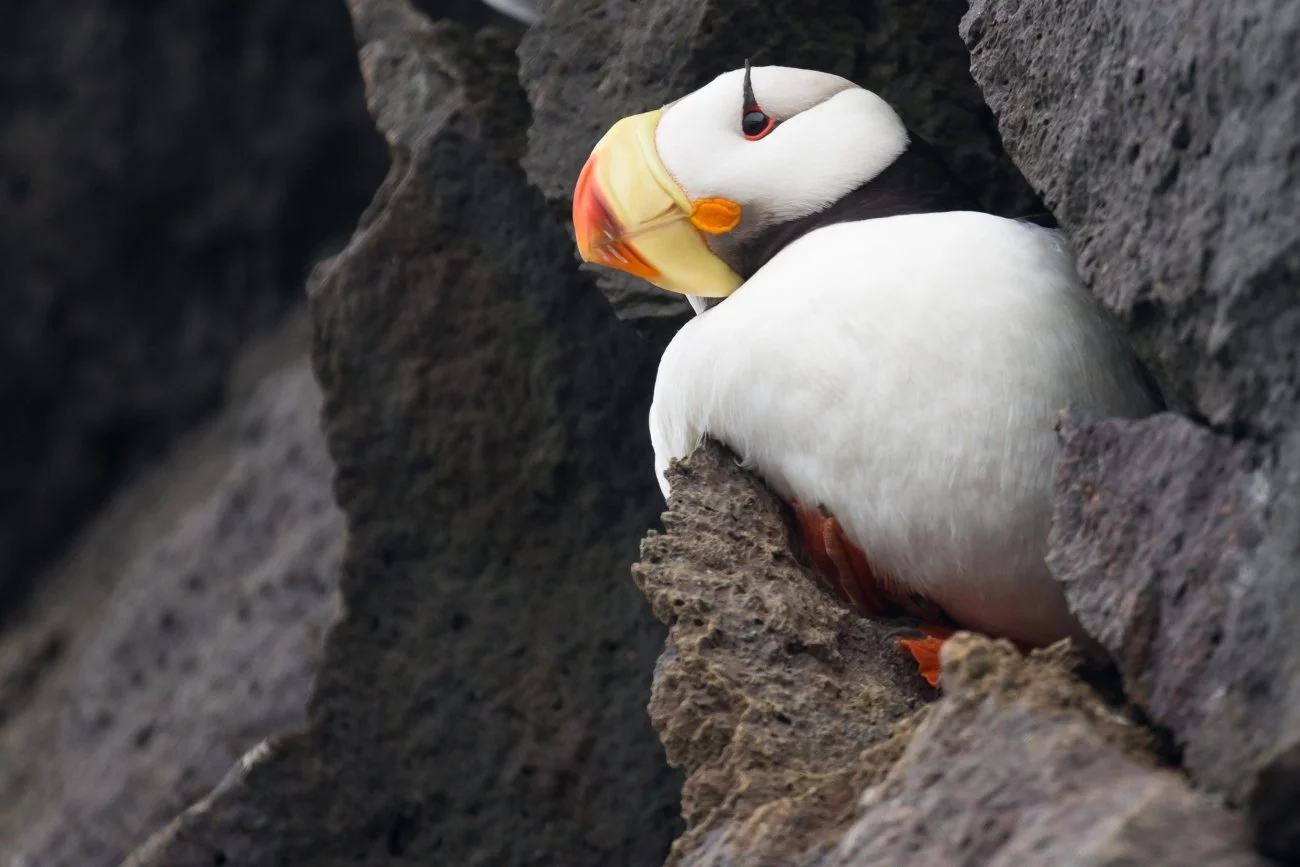
Photo credit: Lisa Hupp, USFWS
LIFE HISTORY and Diet
Horned puffins will start migrating to land in May to mate and lay their eggs, though the more Northern puffins may start later due to the late spring. Horned puffin couples are bonded for life, and can be seen rubbing bills. Horned puffin couples can be found rubbing bills with puffins of the same sex who have adjacent nests.
Horned puffins will lay a single white egg on a cliffside or a crevice between boulders, and both parents will incubate the egg for a total of 42 to 47 days in July or early August. The egg is a chalky white and may have some light marks on them, and when they hatch, the puffling will be covered in down. They are able to walk but will stay in their nests. The pufflings’ parents will bring them fish, held horizontally in their bills like the photo above. Around 45 to 55 days later, the puffling will be fledged and ready to return to the ocean with their parents. After the breeding season ends, puffins will shed the outer layer of their bills and will have a smaller, less colorful bill for the winter, and their feathers will become gray.
Horned puffins primarily eat fish. This consists of greenling, capelin, pollock, various salmon species, northern smoothtongue, and sandlance, as well as different types of invertebrates like squid, octopus, krill, and bristleworms. Ornithologists believe that horned puffins forage partially at night because they also catch lanternfish, which is a bioluminescent fish. During the breeding season, they catch smaller fish so their pufflings can more easily swallow.
Check out this video of a baby puffin’s first swim!
THREATS and CONCERNS
Current population estimates for horned puffins are around 1.2 million. Although horned puffins aren’t currently listed as endangered or threatened, they are being increasingly affected by climate change. Like many marine animals, horned puffins are experiencing changes in their food supply as ocean temperatures warm. Boat-based seabird surveys in Prince William Sound found that horned puffin populations may have declined by as much as 79% from 1972 to 1998. Horned puffins in Alaska experienced other mass die-offs in 2016 and 2020 due to starvation linked to warming ocean temperatures.
Alongside a dwindling food supply, horned puffins are also eating more plastics. They often mistake small plastic fragments for food, and even small accumulations of hard plastics in their gut can significantly raise their mortality rates. Ingested plastics also break down and release harmful toxins such as phthalates into the birds’ bodies.
There are some efforts being made to protect puffins in Alaska. Most seabird nesting colonies in Alaska are protected by federal and state laws, and there have been efforts to eradicate human-introduced predators, such as foxes and rats, from islands. Efforts are also being made to learn more about puffins; the USFWS Puffin Island Project outfits birds with geolocators and leg bands to track them.
CULTURAL SIGNIFICANCE
Puffins are used for food and clothing by Native Alaskans. Puffin skins were used to make feather-lined parkas, and beak plates were often strung together to create rattles. Unangax̂ and Inuit people also sew sea beak plates onto the outside of their garments for decoration.
